
Coke County Criminal Court Cases
Coke County divides criminal cases by charge level. The 51st District Court hears felony matters in Robert Lee. The constitutional county court handles the county's Class A and Class B misdemeanor files. The Coke County Justice of the Peace has fine-only misdemeanor, traffic, and magistrate work within its jurisdiction. Robert Lee Municipal Court keeps city ordinance, traffic, and other fine-only matters of the city. Bronte record questions begin with its official city channel because no live Bronte criminal case portal was verified. Federal court records use the separate Western District of Texas system.
The combined Coke County and District Clerk is the custodian for both district and county case files. That makes the office the right place to ask for an information, indictment, docket sheet, order, judgment, sentence, or certified copy. Court coordinator Nydia Garcia supports the district court by email, but the coordinator is not the records desk. A searcher should direct document requests to the clerk, even when the 51st District Court page names the coordinator for scheduling matters.
Two Coke Courts, One Clerk
The shared clerk arrangement is a useful Coke County shortcut, yet it does not merge the courts. A felony cause belongs to the 51st District Court. A Class A or B misdemeanor cause generally belongs to the county court. The same public counter can locate both, but the case number, judge, docket, and legal authority remain tied to the proper court. The distinction matters when a reader asks for a judgment or tries to interpret a setting.
| Court or custodian | Coke County criminal scope | Official contact |
|---|---|---|
| 51st District Court | Felonies and related district proceedings | 13 E. 7th St.; records through clerk at 325-453-2631 |
| Coke County Court | Class A and B misdemeanor files | Combined clerk, 13 E. 7th St.; 325-453-2631 |
| Coke County Justice of the Peace | Fine-only cases, traffic, and magistrate work | Official JP page; traffic line 325-473-2323 |
| Robert Lee Municipal Court | City ordinance, traffic, and fine-only cases | P.O. Box 26; 325-453-2831 |
The official Coke County clerk page shows the office that joins these two county-level record paths. Its layout illustrates why a single counter can serve distinct courts without turning their dockets into one case system.
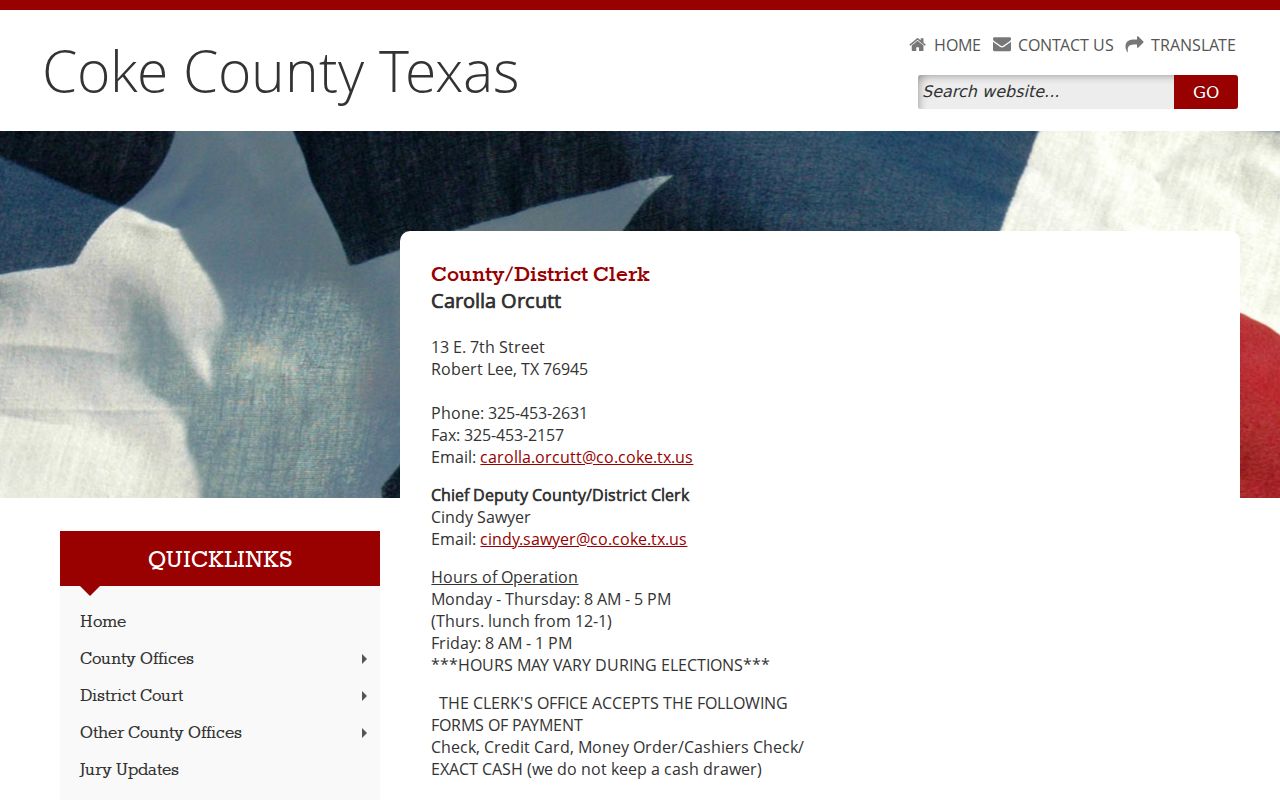
Use the clerk page as the doorway for files and copies, then keep the court named on the cause number in every follow-up request.
Searching Coke County Case Records
Coke County links its judicial search through the clerk rather than offering a separate county-built database. Start with the official clerk page and choose Judicial Case Search. The link leads to iDocket, a vendor-hosted index whose access and visible fields may depend on the session or account. A calendar link can help find a setting, but it is not the complete case file. Save the cause number, court, status, and filing year before calling the clerk.
- Open the Coke County clerk page and follow its Judicial Case Search link to iDocket.
- Select Coke County if the service asks for a county, then search by name and approximate filing year.
- Use the cause number for the tightest match and confirm the court, charge, status, and docket dates.
- Read the docket in order, but treat a calendar or document reference as an index rather than the full filing.
- Call the combined clerk at 325-453-2631 for archived material, plain copies, certified copies, and current charges.
| Search item | Type | Use | Coke County note |
|---|---|---|---|
| Party or defendant name | Text | Starting locator | Try known name forms and verify identity from the case context |
| Approximate year | Date filter | Narrows common names | Use the filing year when known |
| Cause number | Text | Most precise case key | Record it from the result before requesting copies |
| Court | Filter or result field | Separates district and county files | Check municipal and JP channels separately |
| Status or docket event | Result field | Shows case movement | Confirm the final order in the clerk's document |
The iDocket interface is the official search destination reached through the county clerk's site. The captured Coke County court search screen shows why users should preserve the exact labels that appear in their own live session.

When an online field is gated or a document is absent, the clerk's phone and counter remain the authoritative Coke County access channels.
Note: iDocket access and visible fields can vary by session, so record live labels before registering, paying, or requesting a copy.
Coke County Case Calendars
A court calendar answers when a matter may be called. It does not prove what was filed, whether a setting changed, or how a count ended. Coke County searchers can mistake a calendar entry for the criminal case record because both are linked near the clerk's judicial tools. The sound approach is to use the calendar as a clue, then open the docket and request the order or judgment that supports the event.
Statewide access also has a limit. re:SearchTX is Texas's electronic court-document platform, but the Texas Judicial Council data report says criminal case records were historically excluded. Coke County directs local users to iDocket. The statewide portal can still help a reader understand the broader court-document layer, yet it should not replace the Coke County clerk path for a local criminal cause.
The official re:SearchTX screen shows the state platform that many readers may try first. Its source and scope make the local limitation important.
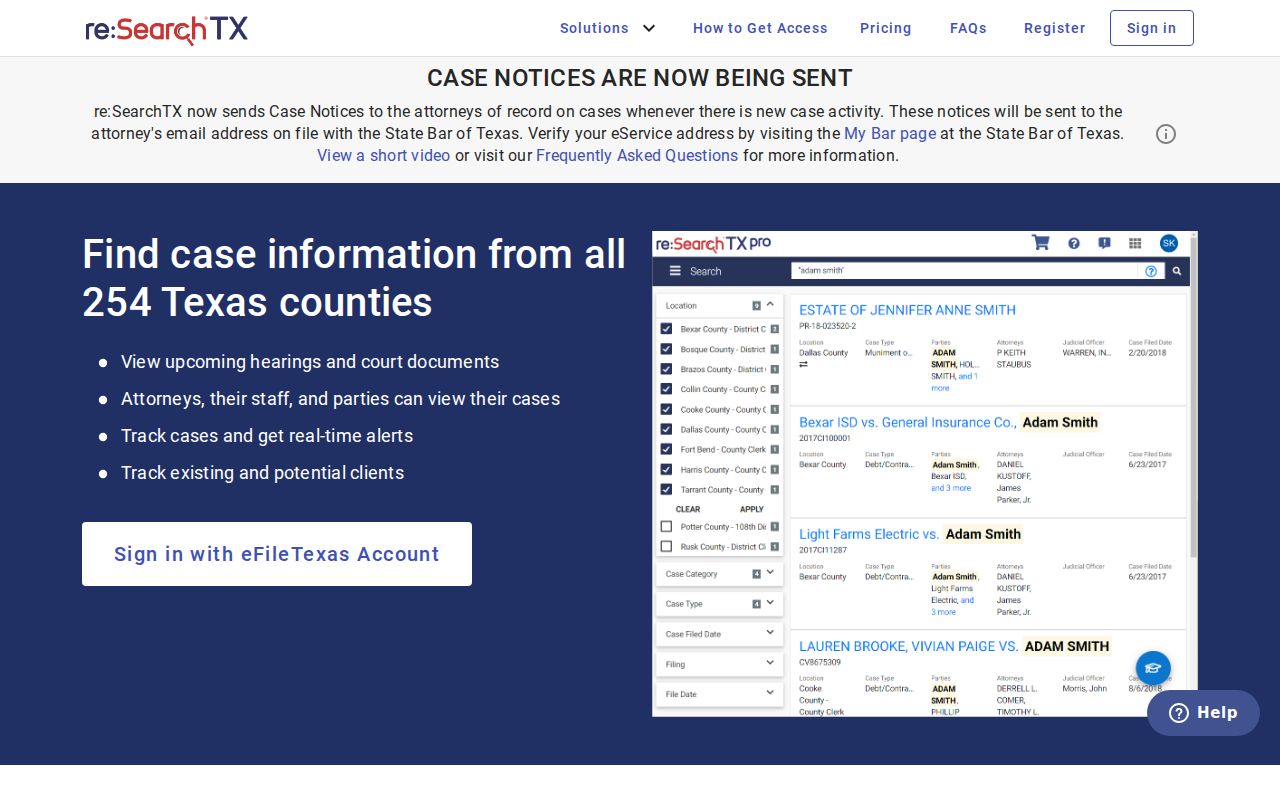
For Coke County criminal court cases, follow the county's iDocket link and ask the combined clerk when the state portal does not supply the criminal file.
Note: A scheduled hearing is one docket event, not the filed charge, final judgment, or whole Coke County criminal case file.
Inside a Coke County Case File
A Coke County criminal file records the prosecution after a charge is filed. It can include a complaint, misdemeanor information, felony indictment, bond papers, motions, notices, plea papers, orders, judgment, sentence, costs, supervision terms, revocation or adjudication motions, capias events, and an appeal notice. Discovery may be mentioned without every attachment being open to the public. Read the docket as a map, then request the document that proves the fact at issue.
| Cause number and court | Identifies the Coke County case and whether it belongs to district, county, justice, or municipal jurisdiction. |
|---|---|
| Charging document | The complaint, information, or indictment states the charge that moved into court, which can differ from booking. |
| Docket entries | A dated register of settings, filings, orders, pleas, and later enforcement events. |
| Hearings and parties | May identify settings, attorneys, and court activity, subject to access limits. |
| Disposition and judgment | Shows how each count ended and supplies the formal court result. |
| Sentence and conditions | Records punishment, costs, confinement, or community-supervision terms when imposed. |
A case file is not a statewide rap sheet. The clerk focuses on the cause, filings, and result, while DPS compiles reported arrest cycles and dispositions. A Coke County court judgment should be read at the count level, especially when one count was dismissed and another produced a plea.
Coke County Felony Court Desk
The official 51st District Court page names Judge Carmen Symes Dusek and lists criminal coordinator Nydia Garcia as an email-only contact. The distinction between coordination and custody prevents a common wrong turn: the coordinator can address administrative court matters, while the combined clerk holds the Coke County criminal case records and supplies copies.
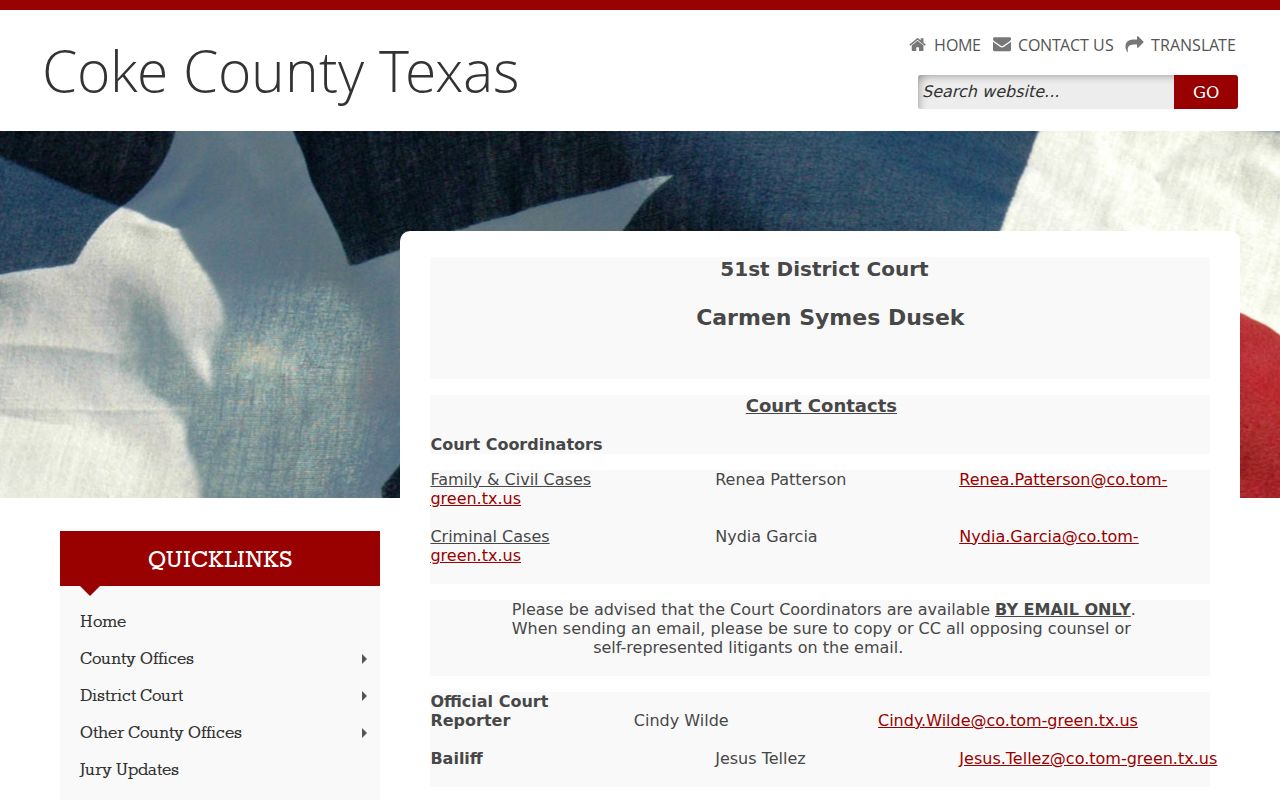
The court page confirms the named felony court, but records requests should still identify the cause and go through the clerk at the courthouse.
The Coke County District Attorney page represents another part of the case path. The prosecutor screens felony matters and presents grand-jury cases, yet the filed charging instrument and later court orders belong in the clerk's cause file.
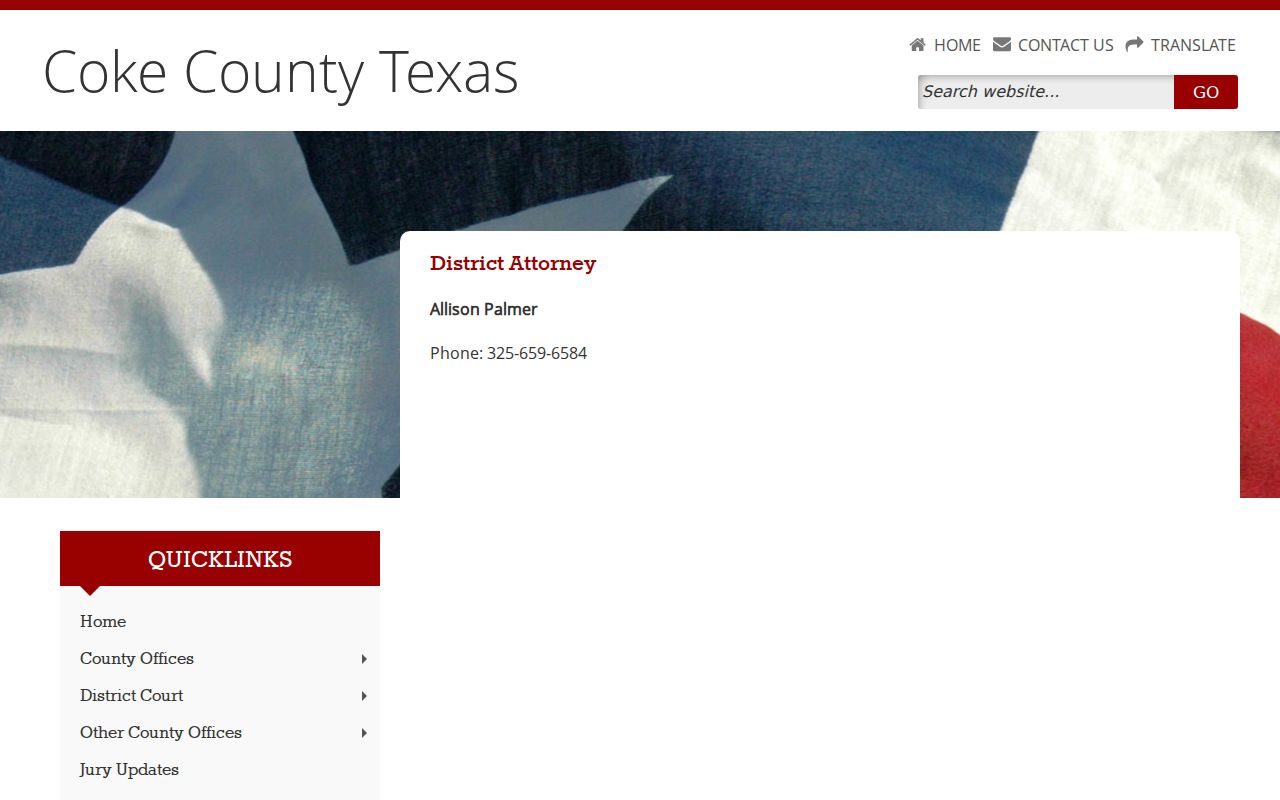
Together, these sources show the split between prosecuting a Coke County case, coordinating a court setting, and preserving the public court record.
How a Criminal Case Moves
A Coke County case can begin with an arrest or citation, followed by magistration and a bond decision. The prosecutor then screens the facts. A misdemeanor may proceed by information, while a felony may go to a grand jury for an indictment. Arraignment and plea come before pretrial settings and motions. A negotiated plea, trial, dismissal, or other disposition leads to a judgment and, when applicable, sentence. Appeal or community-supervision enforcement can add later docket events.
Case flow: Charges Filed › Arraignment › Pretrial › Plea or Trial › Disposition › Sentencing
The filed charge controls the court case. A booking charge is preliminary and can change after prosecutor review. Readers tracing the earlier event can consult the county's Coke County arrest lookup, then return to the court cause for the filed charge and outcome.
Read Coke County Case Outcomes
Short status words can hide major differences. Coke County court records should be read with the order or judgment, not just a search-result label. A pending cause has not established guilt. A dismissal ends a charge without a conviction but does not automatically erase the record. Deferred adjudication withholds a finding of guilt while a person completes court-ordered supervision, and it is not the same as an acquittal.
- No-bill
- A grand jury declines the proposed felony indictment.
- Dismissed
- The charge ends without a conviction, subject to the terms shown in the Coke County file.
- Deferred adjudication
- The court withholds a guilty finding during qualifying community supervision.
- Convicted
- A judgment of guilt follows a plea or verdict and should be paired with the sentence.
- Disposition
- The way a charge or case ended, which must be checked count by count.
Texas expunction and nondisclosure rules are separate questions. A label alone does not establish eligibility. Use the full Coke County disposition, arrest episode, and final order when reviewing a remedy.
Archived Coke Cases and Copies
If iDocket does not show an older Coke County cause or its document, contact the combined clerk. Supply the defendant's name, approximate filing year, court level, and cause number when known. Ask whether the file is online, at the counter, or archived. Also state whether a plain or certified copy is needed. The clerk links a fee schedule effective January 1, 2024, but the research did not verify a flat criminal-copy charge, so confirm the current amount before ordering.
Coke County and District Clerk
13 E. 7th St.
Robert Lee, TX 76945
325-453-2631
Monday through Thursday, 8 a.m. to 5 p.m.; Friday, 8 a.m. to 1 p.m.
The office accepts check, credit card, money order or cashier's check, and exact cash because it does not keep a cash drawer. Election duties can change hours. Call before a visit and never assume a property-record fee applies to a Coke County criminal case request.
Note: Confirm criminal-copy charges with the clerk; the published schedule does not prove one flat price fits every request.
Case Record Access & Restrictions
Open access does not make every Coke County filing public. Juvenile cases, expunged records, nondisclosed criminal history, victim or minor identifiers, protected account and license data, and some active or sealed material can be withheld or redacted. Some older fine-only municipal records can become confidential under Texas Code of Criminal Procedure Article 45A.056. An online view may therefore contain less than the clerk's file, while the clerk still must apply the governing restriction.
Texas access rules: Government Code Chapter 552 governs public information and exceptions, while judiciary rules and local court procedure control clerk-held court records.
When a Coke County case does not appear, ask the clerk whether the cause is indexed under another name form, archived, restricted, or held by a different court. Contact Robert Lee Municipal Court for city matters and the JP for justice-court matters. Do not send a court-file request to the sheriff merely because an arrest began the episode. The sheriff holds the incident and booking layers; the clerk holds the filed prosecution.
Note: Redaction can hide protected fields while leaving the rest of a Coke County court record available for lawful public review.